
Key Takeaways
- OSHA Standard 1926.51 mandates specific toilet-to-worker ratios on all construction sites
- Violations can result in fines up to $15,625 per serious violation as of 2026
- Restrooms must be located within 10 minutes or quarter-mile of work areas
- ADA-compliant units are required on all commercial construction projects
- Regular servicing is mandatory—unsanitary units constitute a separate violation
Construction site compliance isn't just about hard hats and harnesses. The Occupational Safety and Health Administration maintains strict standards for worker sanitation facilities that every contractor must understand and implement. As we move through 2026, OSHA continues enforcing these regulations with substantial penalties for violations—making compliance not just a legal requirement but a critical business consideration.
At Primeway Porta Potty Rental Phoenix, we work daily with general contractors, project managers, and safety officers across Maricopa County to ensure their sites meet or exceed OSHA sanitation requirements. This comprehensive guide breaks down exactly what you need to know about portable toilet regulations for construction sites in 2026.
Understanding OSHA Standard 1926.51
OSHA's sanitation requirements for construction sites fall under 29 CFR 1926.51, the standard governing sanitation facilities across all construction work. This regulation applies to every construction employer, regardless of project size or duration. The standard addresses several key areas:
- Required number of toilet facilities based on workforce size
- Accessibility requirements from work areas
- Minimum standards for facility construction and maintenance
- Hand washing requirements
- Exceptions and special circumstances
Understanding each component helps contractors develop compliant sanitation plans before OSHA inspectors arrive on site.
Worker-to-Toilet Ratios: The Foundation of Compliance
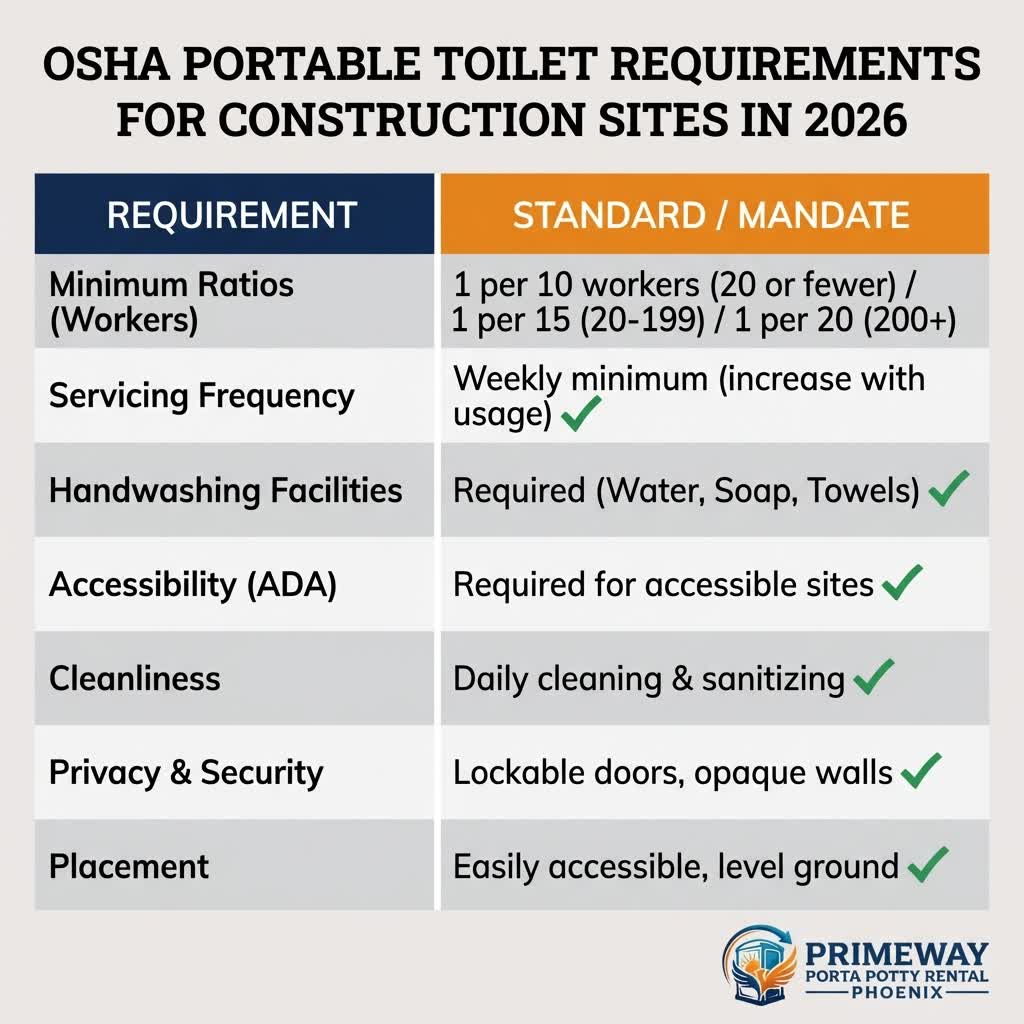
OSHA's most frequently cited sanitation provision involves the required ratio of toilet facilities to workers. These requirements are specific and non-negotiable:
| Number of Workers | Required Toilets | Required Urinals |
|---|---|---|
| 15 or fewer | 1 toilet seat | Not required |
| 16 to 35 | 1 toilet seat | 1 urinal |
| 36 to 55 | 1 toilet seat | 2 urinals |
| 56 to 80 | 2 toilet seats | 2 urinals |
| 81 to 110 | 2 toilet seats | 3 urinals |
| 111 to 150 | 3 toilet seats | 3 urinals |
| Over 150 | 1 per 40 workers | 1 per 50 workers |
Important notes on these ratios:
- These are minimums—providing additional facilities often improves worker satisfaction and productivity
- Toilet seats and urinals cannot be combined—a toilet seat counts only as a toilet seat
- Peak workforce numbers determine requirements, not average daily attendance
- Shift changes don't reset requirements if workers overlap
Accessibility Standards: Location Requirements
Having the right number of units means nothing if workers can't reasonably access them. OSHA requires that toilet facilities be:
- Readily accessible—defined as within a quarter-mile or approximately 10-minute walk from any work location
- Located on the same site when possible
- Available during all working hours
- Accessible without climbing stairs or ladders when feasible
On large construction sites common in Phoenix's sprawling developments, these accessibility requirements often necessitate multiple clusters of portable restrooms rather than centralized facilities. For projects spanning many months, long-term porta potty rental strategies help maintain compliance throughout extended timelines. A 50-acre commercial project with crews working at distant corners cannot comply with a single unit location.
ADA Compliance: Accessibility for All Workers
The Americans with Disabilities Act intersects with OSHA requirements on construction sites. For a complete guide to ADA porta potty requirements on job sites, see our dedicated resource. While OSHA doesn't specifically mandate ADA-compliant portable restrooms, the ADA requires that employers provide accessible facilities for workers with disabilities. In practice, this means:
- ADA-compliant porta potties must be available when workers with disabilities are present
- Even without known disabled workers, many contractors include at least one ADA unit as standard practice
- Public-facing construction projects typically require ADA facilities as part of site permits
- Phoenix and Maricopa County may have additional accessibility requirements beyond federal standards
ADA portable restrooms feature:
- Ground-level entry without steps
- Interior space for wheelchair maneuverability
- Grab bars and accessible toilet heights
- Wider door openings
- Accessible door handles and latches
Hand Washing Requirements: Beyond the Basics
OSHA Standard 1926.51(f) requires that hand washing facilities be provided alongside toilet facilities. Construction sites must offer:
- Either separate hand washing stations or combined units with sinks
- Potable water for hand washing
- Soap or appropriate cleaning agents
- Individual hand towels, warm air blowers, or clean individual sections of continuous towel supply
- Waste receptacles for used towels
Hand sanitizer alone does not satisfy OSHA hand washing requirements, though it can supplement proper washing stations. The COVID-19 pandemic heightened awareness of hand hygiene, and OSHA continues emphasizing these provisions in inspections.
Service and Maintenance: Keeping Facilities Usable
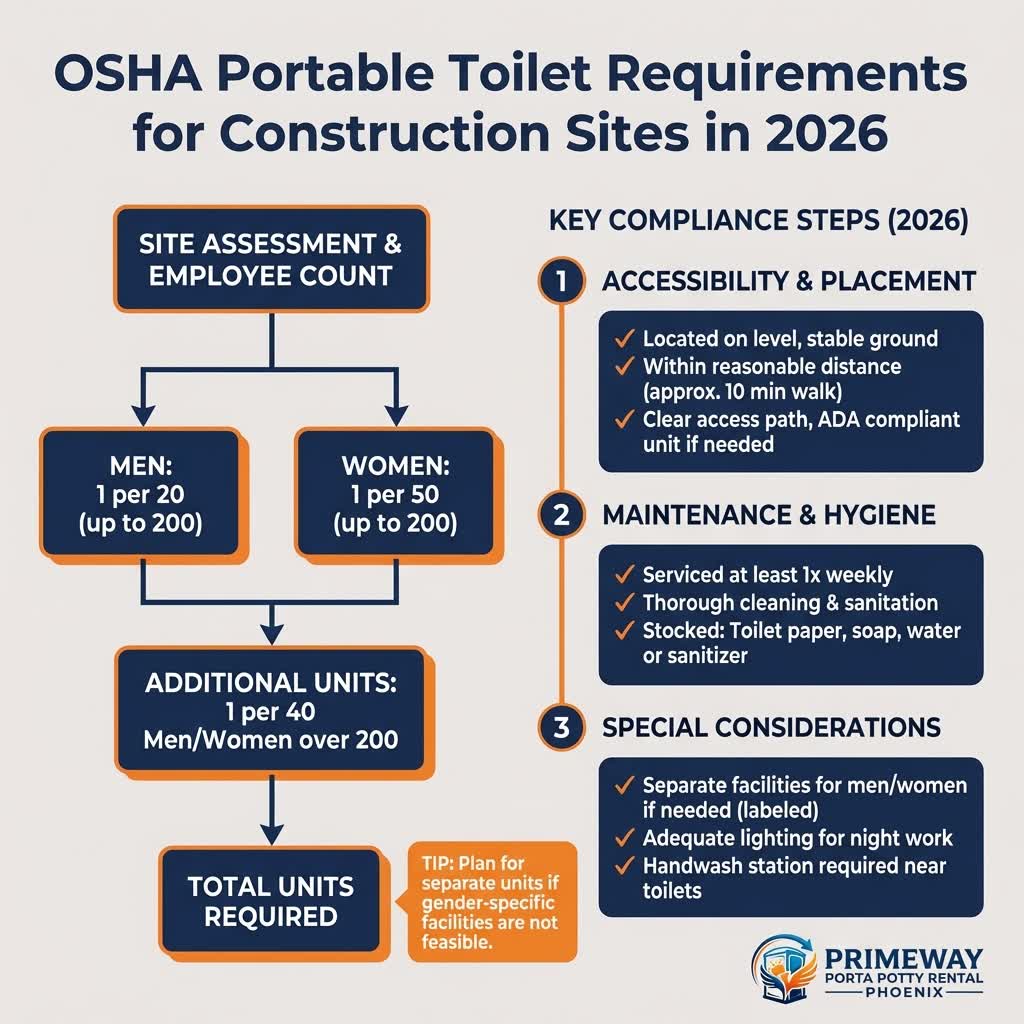
OSHA requires that toilet facilities be maintained in a sanitary condition. This seemingly simple requirement creates ongoing obligations:
Cleaning Frequency
While OSHA doesn't specify exact cleaning intervals, facilities must remain sanitary given usage levels. For typical construction porta potties, this generally means:
- Weekly service for low-usage sites (1-10 workers)
- Twice-weekly service for moderate usage (11-30 workers)
- Three or more weekly services for high-usage sites
Supply Maintenance
Hand washing stations require continuous monitoring:
- Soap dispensers must remain filled
- Paper towels or drying methods must be available
- Water tanks require regular refilling on non-plumbed units
Immediate Issues
Broken units, overflowing toilets, or vandalized facilities must be addressed promptly. A non-functional unit doesn't count toward your OSHA-required numbers, and leaving unsanitary units in place creates separate violations.
Documentation and Record-Keeping
While OSHA doesn't require specific sanitation documentation, maintaining records protects contractors during inspections. Recommended documentation includes:
- Service contracts with portable sanitation providers
- Service logs showing cleaning dates and times
- Photos of unit placement and quantity
- Workforce headcounts demonstrating compliance calculations
- Any complaints and their resolution
During an OSHA inspection, being able to demonstrate proactive compliance efforts often influences citation decisions and penalty levels.
Penalties and Enforcement: The Cost of Non-Compliance
OSHA takes sanitation violations seriously. As of 2026, penalty structures include:
- Serious violations: Up to $15,625 per violation
- Willful or repeated violations: Up to $156,259 per violation
- Failure to abate: Up to $15,625 per day beyond the abatement date
Multiple violations often accompany sanitation inspections—inadequate numbers, poor placement, and unsanitary conditions can result in several separate citations. A single inspection can easily generate tens of thousands in penalties.
Beyond OSHA fines, non-compliance creates:
- Work stoppages while violations are corrected
- Project delays and associated costs
- Reputational damage with clients and partners
- Increased scrutiny on future projects
Need OSHA-Compliant Sanitation?
We help Phoenix contractors meet all OSHA requirements. Get a compliant rental package today.
Call (602) 669-0858Special Situations and Exceptions
Several circumstances affect standard OSHA sanitation requirements:
Mobile Crews
Road construction, utility work, and similar mobile operations have modified requirements. When workers move frequently, portable sanitation can follow crews or alternative arrangements may satisfy OSHA if access to permanent facilities remains reasonable.
Remote Sites
Truly remote locations without service access may qualify for alternative compliance methods. However, "remote" is strictly interpreted—most Phoenix-area construction doesn't qualify given the region's developed infrastructure.
Temporary Exemptions
OSHA may grant temporary exemptions for unusual circumstances, but these require advance application and justification. Don't assume an exemption exists—verify with OSHA before operating without required facilities.
State and Local Requirements: Arizona-Specific Rules
While OSHA sets baseline federal standards, Arizona operates under an OSHA-approved State Plan. The Arizona Division of Occupational Safety and Health (ADOSH) generally mirrors federal standards but may have additional requirements. Phoenix and Maricopa County may impose further conditions through building permits and site approvals.
Key Arizona considerations:
- ADOSH maintains authority to inspect and cite construction sites
- State penalties may differ slightly from federal OSHA
- Local permitting often requires documented sanitation plans
- Monsoon season and extreme heat create additional worker welfare considerations
Best Practices for Proactive Compliance
Beyond meeting minimum requirements, proactive contractors implement best practices that protect both workers and businesses:
- Plan early: Include sanitation in pre-construction planning, not as an afterthought
- Over-provide slightly: Extra capacity prevents compliance issues if workforce grows unexpectedly
- Document everything: Maintain service records, photos, and workforce calculations
- Respond quickly: Address maintenance issues within hours, not days
- Train supervisors: Ensure field leadership understands requirements and monitoring responsibilities
- Review regularly: Assess compliance as workforce sizes and site layouts change
- Partner with professionals: Work with experienced portable sanitation providers who understand construction needs
At Primeway Porta Potty Rental Phoenix, we don't just rent porta potties—we help contractors develop compliant sanitation strategies. Our team understands OSHA requirements and Arizona's specific construction environment. We calculate appropriate unit quantities, recommend service schedules, and provide documentation that supports your compliance efforts.
OSHA compliance isn't optional, and it isn't complicated when you work with knowledgeable partners. Protect your workers, your project timeline, and your bottom line by taking portable sanitation seriously from day one.
Learn more about hand washing requirements on job sites or explore our guide to ADA compliance for construction sites.