Key Takeaways
- ADA porta potties must meet strict federal standards for size, features, and accessibility
- At least 5% of units at events must be ADA compliant, with a minimum of one unit
- Construction sites must provide ADA accessible restrooms when they have workers with disabilities
- ADA units require 60-inch turning radius, ground-level access, and specific grab bar placement
- Non-compliance can result in fines, lawsuits, and event permit denial in Arizona
When planning an event or managing a construction site in Phoenix, ensuring accessibility isn't just good business—it's the law. The Americans with Disabilities Act (ADA) sets strict requirements for portable restrooms that every event planner, contractor, and business owner must understand. At Primeway Porta Potty Rental Phoenix, we've helped thousands of clients navigate these requirements. This comprehensive guide breaks down everything you need to know about ADA porta potty requirements in Arizona.
What Makes a Porta Potty ADA Compliant?
ADA compliant portable restrooms are specifically designed to accommodate people with mobility impairments. These aren't simply larger units—they feature specialized engineering that meets federal accessibility standards established by the Department of Justice and enforced under the Americans with Disabilities Act of 1990.
Interior Dimensions and Space Requirements
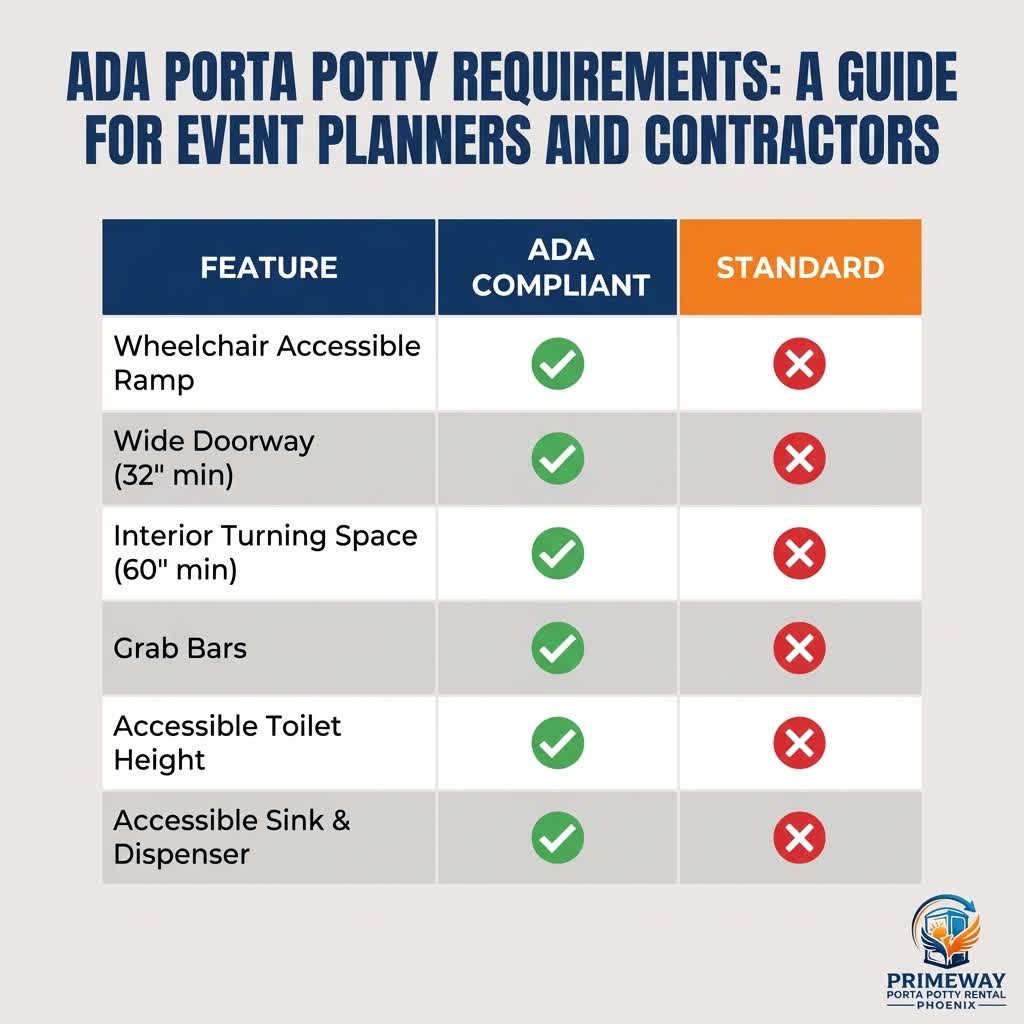
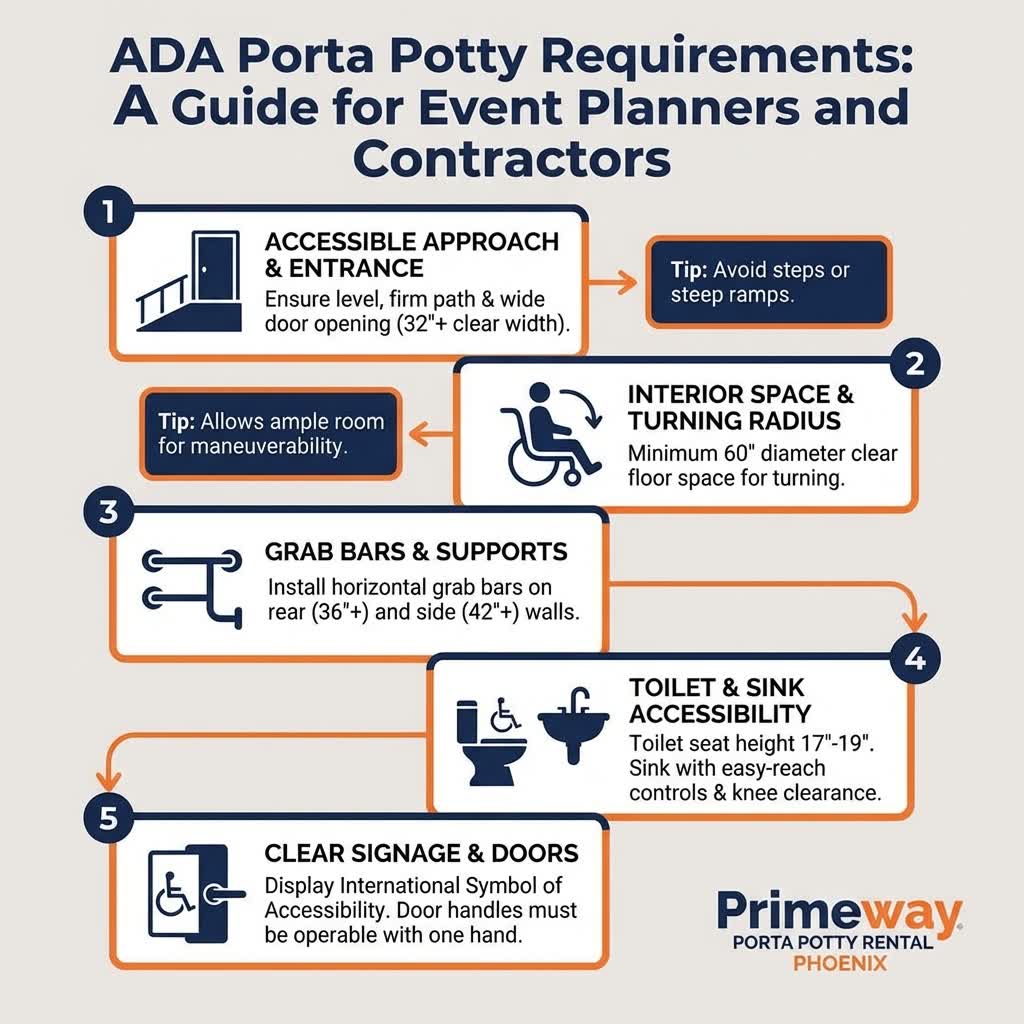
One of the most critical ADA porta potty requirements involves interior space. The unit must provide enough room for a wheelchair user to enter, close the door, and maneuver comfortably. According to ADA Standards for Accessible Design (ADAAG), compliant units must have:
- A minimum 60-inch turning radius for wheelchair maneuverability
- Interior dimensions typically 62 inches wide by 86 inches deep minimum
- Entry door width of at least 32 inches clear opening
- Sufficient floor space to approach fixtures from a forward or parallel position
These dimensions aren't arbitrary—they're based on extensive research into wheelchair sizes and turning capabilities. Standard wheelchairs range from 25 to 32 inches wide, and users need adequate space to turn 180 degrees without assistance.
Ground-Level Access Requirements
Unlike standard porta potties that often require steps or ramps, ADA compliant units must be ground accessible. This means:
- No steps or abrupt level changes at the entrance
- Threshold height cannot exceed ½ inch
- Self-leveling systems to maintain stability on uneven terrain
- Non-slip flooring surfaces that accommodate wheelchair casters
At outdoor events in Phoenix, where desert terrain can be challenging, proper placement becomes crucial. The ground around the unit must be firm, stable, and slip-resistant—especially important during monsoon season when sudden rains can create muddy conditions.
Grab Bars and Support Features
ADA porta potty requirements mandate specific grab bar configurations to assist with transfers and stability:
| Feature | Specification | Purpose |
|---|---|---|
| Side grab bar | 42 inches long, 33-36 inches high | Assists lateral transfers |
| Rear grab bar | 36 inches long, 33-36 inches high | Supports sitting/standing |
| Bar diameter | 1.25-1.5 inches | Easy gripping surface |
| Wall clearance | 1.5 inches minimum | Hand room behind bar |
| Weight capacity | 250+ pounds | Safe support for adults |
These grab bars must be securely mounted and capable of supporting significant weight. High-quality ADA porta potties feature reinforced wall structures specifically designed for this purpose.
ADA Requirements for Events and Public Gatherings
For event planners in Phoenix, understanding the ratio and placement requirements is essential for permit approval and legal compliance.
Minimum ADA Unit Ratios
The ADA requires that at least 5% of portable restrooms at public events be wheelchair accessible, with a minimum of one ADA unit regardless of total quantity. This means:
- Events with 1-20 total units: Minimum 1 ADA unit
- Events with 21-40 total units: Minimum 2 ADA units
- Events with 41-60 total units: Minimum 3 ADA units
- Events with 61+ units: 5% of total must be ADA compliant
However, these are minimums. Many accessibility advocates recommend exceeding these ratios, particularly for events that specifically serve disability communities or seniors. Additionally, if your event spans multiple areas or zones, each zone should have its own accessible restroom within a reasonable distance.
Placement and Signage Requirements
Simply having ADA units isn't enough—they must be properly positioned and identified:
- Accessible units should be located on the shortest accessible route to other event amenities
- Signage must display the international symbol of accessibility
- Signs should be mounted at appropriate heights for wheelchair users
- Units cannot be blocked by vendor booths, vehicles, or equipment
- Pathways to units must meet ADA accessible route standards
We've seen events fail inspection because ADA porta potties were placed behind food trucks, up steep inclines, or in areas that flooded during afternoon storms. Proper site planning prevents these issues.
ADA Compliance for Construction Sites
Construction sites in Arizona face their own set of ADA porta potty requirements, enforced by both the Department of Justice and OSHA. Understanding the intersection of these regulations helps contractors maintain compliance while protecting workers.
When ADA Units Are Required
Construction sites must provide ADA accessible portable toilets when:
- Workers with disabilities are employed on-site
- The site is open to public inspection or tours
- Subcontractors bring workers with disabilities
- Site conditions make standard units inaccessible to workers with temporary injuries
Even if no workers currently have disabilities, many contractors proactively include ADA units. This prevents scrambling when new workers arrive and demonstrates commitment to inclusive worksites.
OSHA and ADA Intersection
While OSHA sets baseline sanitation requirements, the ADA adds accessibility layers. Construction sites must satisfy both:
| Requirement | OSHA Standard | ADA Addition |
|---|---|---|
| Unit quantity | 1 per 20 workers | 5% must be accessible |
| Location | Within 10-minute walk | Accessible route required |
| Maintenance | Regular servicing | Accessibility features functional |
| Signage | Basic identification | International accessibility symbol |
At Primeway Porta Potty Rental Phoenix, we help contractors navigate these overlapping requirements to ensure full compliance during Arizona Department of Transportation and city inspections.
Arizona-Specific Accessibility Considerations
While ADA is federal law, Arizona and Maricopa County have additional requirements that affect porta potty rentals.
Maricopa County Event Permit Requirements
Events in Phoenix, Scottsdale, Tempe, and surrounding areas must comply with Maricopa County Environmental Services Department regulations. For events requiring permits, you'll need to specify:
- Number of ADA units provided
- Placement diagram showing accessible routes
- Proof that units meet current ADA standards
- Service schedule for multi-day events
Permit applications are typically denied if accessibility plans are incomplete. Working with an experienced porta potty provider helps ensure your application includes all necessary documentation.
Climate Considerations for Phoenix Events
Phoenix's extreme heat creates unique accessibility challenges. During summer months when temperatures exceed 110°F, ADA porta potty requirements extend to:
- Shade structures protecting accessible routes
- Heat-resistant grab bars that don't burn users
- Ventilation systems adequate for extended occupancy
- Extra spacing for cooling equipment
Metal grab bars can reach 150°F+ in direct Arizona sun. Quality ADA units feature insulated or coated bars that remain usable even during Phoenix summers.
Need ADA Compliant Porta Potties in Phoenix?
We provide fully compliant ADA portable restrooms for events and construction sites across Arizona. Call for a free quote.
Call (602) 669-0858Common ADA Compliance Mistakes to Avoid
Even well-intentioned planners make mistakes that create compliance issues. Here are the most common errors we encounter:
Insufficient Turning Space Inside
Some "accessible" units on the market meet basic size requirements but fail the functional test. A wheelchair user must be able to close the door and turn around without exiting. Always verify that units provide true 60-inch turning radius, not just minimum dimensions.
Improper Slope and Leveling
ADA requires accessible units to be placed on surfaces that don't exceed 2% slope in any direction. On construction sites, this often requires grading or using leveling platforms. We've seen units tip during use because they were placed on uncompacted fill dirt.
Blocking Access Routes
Vendors, caterers, and even event staff frequently block accessible routes by placing equipment, vehicles, or trash bins in pathways. Clear communication with all parties about maintaining accessible routes is essential. Consider using cones or barriers to protect these paths.
Missing or Inadequate Signage
ADA units must be clearly identified with the international accessibility symbol. Temporary paper signs taped to doors don't meet requirements. Units should have permanent, weather-resistant signage mounted at appropriate heights.
ADA Porta Potty Features and Options
Modern ADA porta potties offer features beyond basic compliance. Understanding these options helps you select appropriate units for your specific needs.
Standard ADA Units
The most common option meets all federal requirements with:
- Spacious interior with 60-inch turning radius
- Ground-level access with minimal threshold
- Properly positioned grab bars
- Slip-resistant flooring
- Accessible door handles and locks
High-Capacity ADA Units
For multi-day events or high-traffic construction sites, high-capacity ADA units offer:
- Larger waste tanks (reducing service frequency)
- Reinforced construction for heavy use
- Enhanced ventilation systems
- Optional hand sanitizer dispensers
Climate-Controlled Accessible Restrooms
For upscale events or extreme conditions, climate-controlled options provide:
- Air conditioning for Phoenix summers
- Heating for winter events
- LED lighting for evening use
- Interior sinks with running water
These premium units exceed standard ADA porta potty requirements while providing maximum comfort for users.
Documentation and Legal Protection
Maintaining proper documentation protects event planners and contractors from liability claims.
What to Keep on File
For every event or project, retain:
- Delivery receipts showing ADA unit quantities
- Photos of unit placement and accessible routes
- Service records for multi-day rentals
- Permit applications (showing compliance)
- Correspondence with your porta potty provider
Insurance Considerations
Many general liability policies require ADA compliance as a condition of coverage. Non-compliance with ADA porta potty requirements could void coverage if a claim arises. Verify with your insurance provider that your accessibility plans meet policy conditions.
Working with a Qualified Provider
Not all porta potty companies understand ADA requirements thoroughly. When selecting a provider, ask:
- How long have you provided ADA compliant units?
- Do your units meet current ADAAG standards?
- Can you provide placement guidance for compliance?
- What documentation do you provide for permits?
- How do you ensure grab bars and features are properly maintained?
At Primeway Porta Potty Rental Phoenix, we've supplied ADA compliant portable restrooms to hundreds of Arizona events and construction projects. Our team understands the specific requirements that Arizona event planners and contractors face, from Maricopa County permits to Phoenix summer heat challenges.
Understanding ADA porta potty requirements isn't just about avoiding penalties—it's about creating inclusive spaces where everyone can participate. Whether you're planning a wedding in Scottsdale, managing a construction site in downtown Phoenix, or organizing a festival in Tempe, proper accessibility planning shows that your organization values all participants. Contact us today to discuss your specific ADA porta potty needs.