Key Takeaways
- Position units in clusters of 6-10 to reduce perceived wait times
- Implement single-file queuing systems with clear markings
- Separate entry and exit paths to prevent congestion
- Assign attendants to high-traffic clusters during peak hours
- Provide real-time wait time information to manage expectations
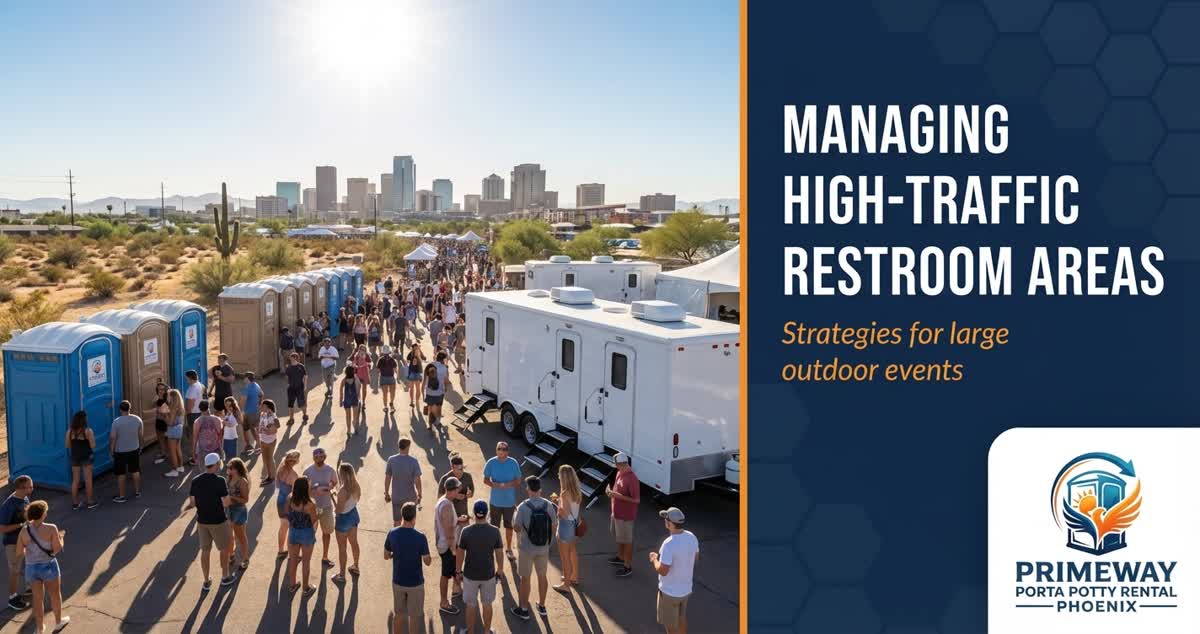
Nothing creates event dissatisfaction faster than long restroom lines. When thousands of attendees converge on limited facilities during peak moments—intermission at a concert, halftime at a sporting event, between sets at a festival—the resulting congestion can spiral into safety issues, negative social media, and even health code violations.
At Primeway Porta Potty Rental Phoenix, we've managed sanitation for some of Arizona's largest outdoor gatherings. Effective crowd management in high-traffic restroom areas requires strategic planning, physical infrastructure, and responsive staffing. This guide covers proven techniques for keeping things moving when demand peaks.
Understanding High-Traffic Patterns
Predictable Demand Surges
Most outdoor events follow predictable restroom usage patterns:
| Event Type | Peak Demand Periods | Usage Multiplier |
|---|---|---|
| Music Festivals | Between sets, end of headliner | 4-6x baseline |
| Sporting Events | Halftime, post-game | 5-8x baseline |
| Food Festivals | Meal times, post-eating | 3-4x baseline |
| Fireworks Shows | Immediately following display | 10x+ baseline |
| Concerts | Intermission, immediately after | 6-10x baseline |
Planning for these surges—not average usage—determines whether your facilities succeed or fail under pressure.
Geographic Concentration
High-traffic areas cluster naturally:
- Near main stages or performance areas
- Adjacent to food and beverage zones
- At venue entrances and exits
- Near transportation hubs (shuttle stops, parking)
- At transition points between venue areas
Identifying these hotspots during planning allows proactive crowd management rather than reactive crisis response.
Physical Layout Strategies
The Cluster Approach
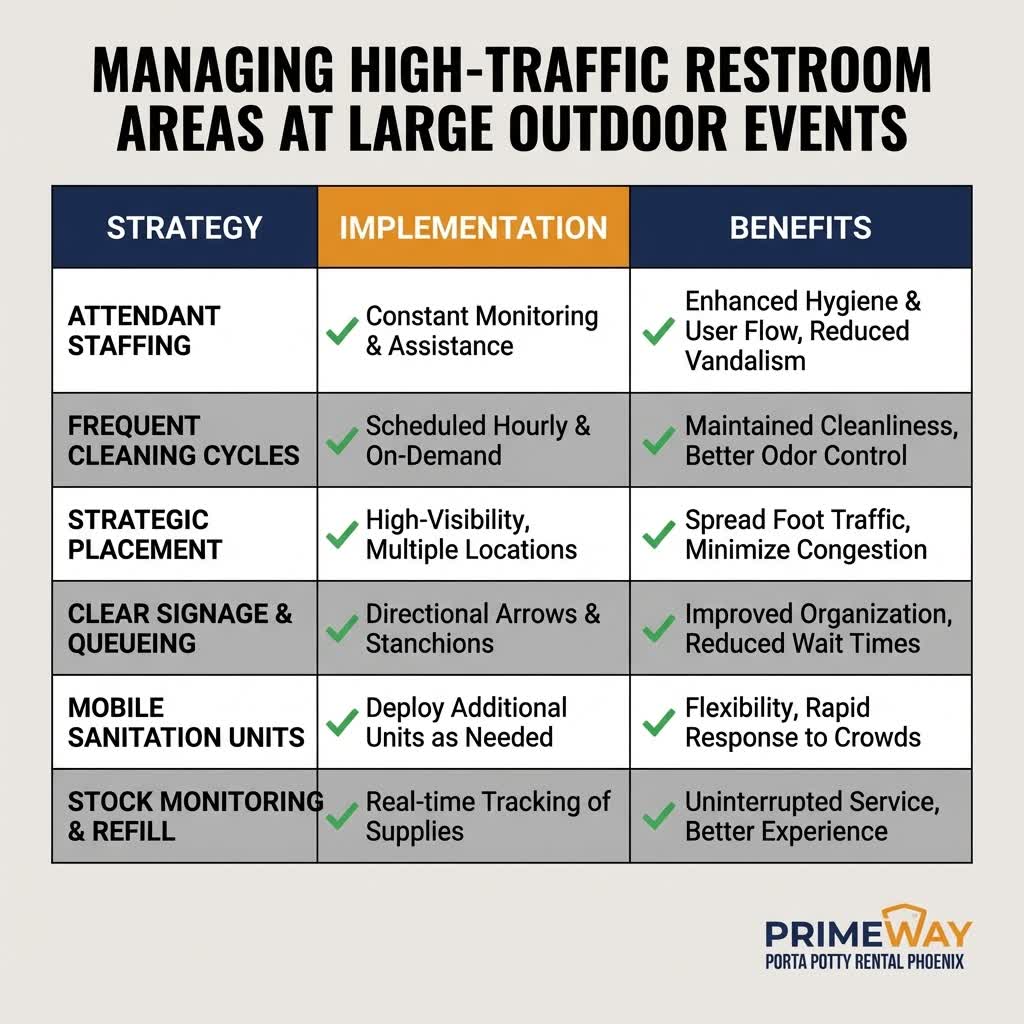
Rather than distributing units evenly, concentrate them in strategic clusters:
Benefits of clustering:
- Reduces walking distance uncertainty—attendees can see multiple options
- Enables efficient staffing (one attendant manages multiple units)
- Creates economies of service (pumping, restocking)
- Allows backup capacity when individual units go out of service
Optimal cluster size: 6-12 units per location. Smaller clusters create bottlenecks; larger clusters become unwieldy to manage.
Flow Design Principles
Directing movement prevents chaos:
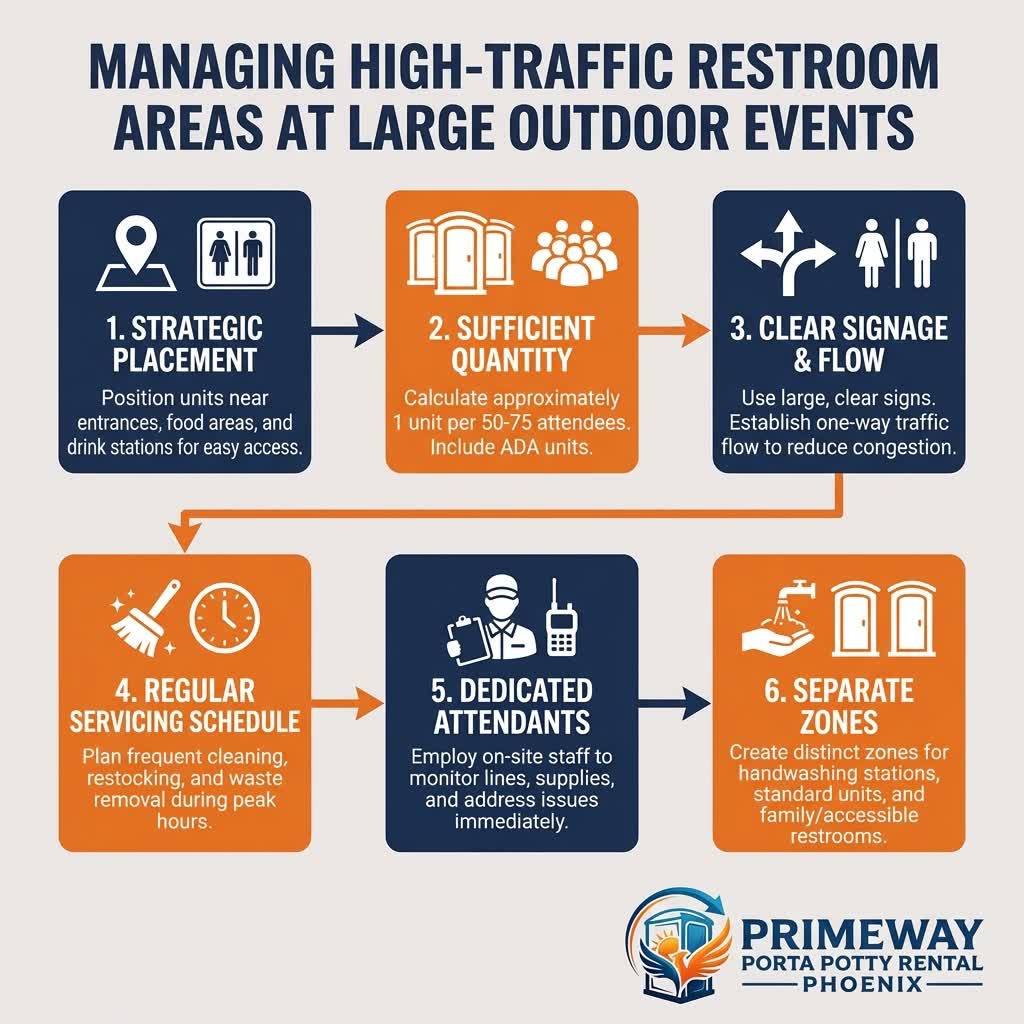
- Dedicated entry lanes: Marked paths approaching the cluster from high-traffic directions
- Single queue feeding multiple units: More efficient than individual lines per unit
- Exit paths that don't cross entry lanes: Prevents gridlock
- Buffer zones: Open space around clusters for queue overflow
Queuing Infrastructure
Physical queue management tools:
| Tool | Best Application | Cost Level |
|---|---|---|
| Retractable belt barriers | Formal events, VIP areas | Moderate |
| Plastic crowd control stanchions | General admission, flexible layouts | Low |
| Cones and caution tape | Temporary adjustments, emergencies | Minimal |
| Ground markings/paint | Permanent or semi-permanent venues | Low (ongoing) |
| Natural barriers (fencing, walls) | Any venue with existing structures | None |
Staffing for Crowd Control
The Attendant Role
Trained attendants transform restroom operations:
Traffic management duties:
- Directing arrivals to shortest lines
- Managing queue flow and preventing line-cutting
- Communicating wait times to attendees
- Coordinating with security for crowd issues
Service duties:
- Continuous restocking of supplies
- Quick cleans between heavy uses
- Blocking out-of-service units immediately
- Reporting maintenance needs
Staffing Ratios
Recommended attendant coverage:
| Cluster Size | Baseline Staffing | Peak Staffing |
|---|---|---|
| 6-8 units | 1 attendant | 2 attendants |
| 9-12 units | 1-2 attendants | 2-3 attendants |
| 13-20 units | 2 attendants | 3-4 attendants + supervisor |
| 20+ units | 3 attendants + supervisor | 5+ attendants + supervisor |
Communication Systems
Attendants need real-time coordination:
- Two-way radios connecting all clusters
- Direct lines to event operations center
- Escalation protocols for crowd control issues
- Status updates on unit availability
Planning a High-Capacity Event?
Get crowd management expertise, high-volume unit clusters, and trained attendant staff.
Call (602) 669-0858Technology Solutions
Wait Time Management
Information reduces frustration:
- Digital displays showing estimated wait times
- Mobile app integration with real-time updates
- Staff with signage indicating "5 min wait" vs "15 min wait"
- Social media updates directing attendees to less crowded facilities
When attendees know what to expect, they're more patient. Uncertainty amplifies perceived wait times.
Capacity Monitoring
Smart systems for large venues:
- IoT sensors tracking unit usage rates
- Automated alerts when facilities approach capacity
- Dashboard views for operations managers
- Predictive analytics for demand surges
Wayfinding Technology
Help attendees find facilities efficiently:
- Digital maps on venue apps showing all locations and real-time capacity
- Dynamic signage directing to less crowded clusters
- Text message updates for ticket holders
Emergency Crowd Management
Overflow Protocols
When demand exceeds capacity:
- Open emergency units kept in reserve
- Deploy portable urinals for male attendees (reduces standard unit demand by 30-40%)
- Direct attendees to secondary clusters with clearer signage
- Temporarily convert staff facilities to public use
Safety Considerations
Crowd density around restrooms creates risks:
- Maintain clear emergency egress paths
- Position security personnel at high-traffic clusters during peak times
- Monitor for heat-related illness in queueing attendees (critical in Phoenix summers)
- Provide water stations near long queues
- Establish medical response protocols for queue emergencies
Incident Response
Rapid response to facility failures:
- Pre-positioned backup units for emergency deployment
- Service trucks on standby during peak periods
- Clear protocols for unit closures and redirection
- Communication plans for informing attendees of alternatives
Gender-Specific Considerations
Women's Wait Time Challenges
Standard planning often underestimates women's facility needs:
- Women's average restroom time: 2-3 minutes
- Men's average restroom time: 30-60 seconds
- Traditional 1:1 gender ratio creates bottlenecks for women
Recommended ratios for high-traffic events: 3:2 or 2:1 female-to-male units. Gender-neutral units can improve efficiency while accommodating all attendees.
Gender-Neutral Solutions
Modern approaches to facility allocation:
- All-gender units with full privacy
- Converting men's units to all-gender during peak demand
- Family/single-occupancy units for those needing assistance
Phoenix-Specific Considerations
Heat Management in Queues
Phoenix's extreme temperatures demand special attention:
- Position high-traffic clusters in shaded areas when possible
- Provide shade structures over queue areas
- Misting systems for outdoor queues (April-October)
- Water stations adjacent to heavily used facilities
- Priority access policies for elderly or heat-sensitive attendees
Dust and Air Quality
Desert events face unique challenges:
- Dust storms can render outdoor queues unbearable
- Air quality alerts may affect outdoor waiting
- Consider covered queue structures for multi-day events
- Monitor weather and adjust staffing for extreme conditions
Communication and Signage
Pre-Event Communication
Set expectations before attendees arrive:
- Venue maps showing all restroom locations
- App notifications about peak times and less crowded alternatives
- Social media posts highlighting facility accessibility
- Email to ticket holders with tips for avoiding long lines
On-Site Signage Strategy
Clear guidance reduces confusion:
- Large directional signs visible from a distance
- "Unit Available/ Occupied" indicators where feasible
- Estimated wait times posted at queue entrances
- Alternative location directions when primary clusters are full
Post-Event Analysis
Data Collection
Document for future planning:
- Peak wait times at each cluster
- Times when overflow protocols activated
- Staff feedback on crowd patterns
- Attendee complaints or compliments about facilities
- Service records showing usage intensity
Continuous Improvement
Use data to refine future events:
- Adjust unit counts based on actual demand patterns
- Relocate clusters that underperformed or overcrowded
- Refine staffing schedules to match peak periods
- Upgrade infrastructure where bottlenecks occurred
Best Practices Checklist
For your next high-traffic event or festival:
- Planning: Model demand for peak periods, not averages
- Layout: Cluster units with dedicated entry/exit flows
- Infrastructure:>/strong> Provide queuing barriers, shade, and wayfinding
- Staffing: Deploy trained attendants at all high-traffic clusters during peaks
- Communication: Inform attendees of wait times and alternatives
- Safety: Maintain emergency egress and monitor for heat issues
- Contingency: Prepare overflow protocols and backup units
- Analysis: Document everything for continuous improvement
Managing high-traffic restroom areas successfully requires thinking beyond unit counts. Strategic placement, crowd flow design, trained staffing, and responsive communication transform potential bottlenecks into smoothly operating systems. The investment in planning pays dividends in attendee satisfaction, safety, and your event's reputation.
For expert porta potty rental with crowd management planning in the Phoenix area, contact Primeway Porta Potty Rental Phoenix. We bring experience from Arizona's largest events to help your gathering handle high-traffic periods with professional efficiency.