
Key Takeaways
- Place units within 200-300 feet of high-traffic areas for convenient access
- Create restroom "clusters" of 3-6 units to reduce wait times and crowding
- Position downwind from dining areas when possible, with visual barriers
- Ensure ADA-compliant units have accessible routes from all event areas
- Provide adequate lighting for evening events and consider security near units
You've chosen the right porta potty types for your event, confirmed delivery timing, and counted your guest list twice. But have you thought carefully about where those units will actually sit? Porta potty placement can make the difference between satisfied guests and frustrated complaints — and it's about far more than just finding a flat spot.
At Primeway Porta Potty Rental Phoenix, we've delivered units to thousands of events across the Valley, from intimate Desert Ridge weddings to massive music festivals. This guide shares the placement strategies we've observed from the most successful events, helping you create a layout that maximizes guest comfort and minimizes problems.
The Fundamentals of Strategic Porta Potty Placement
Effective porta potty placement balances multiple competing priorities: accessibility, aesthetics, logistics, and health considerations. Understanding these fundamentals helps you make informed trade-offs for your specific venue.
The Convenience Zone: Finding the Sweet Spot
Research consistently shows that guests are most satisfied when restrooms are:
- Visible and findable without asking for directions
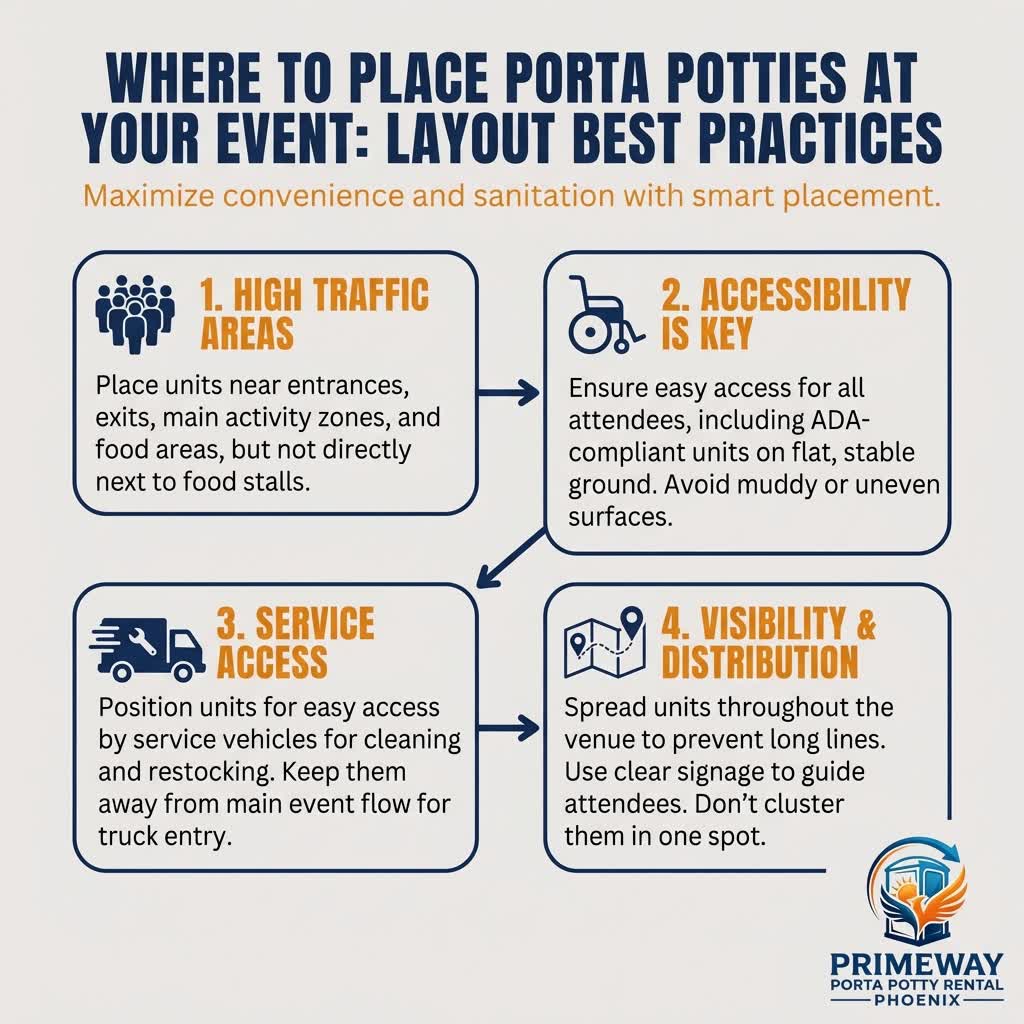
- Within 2-3 minutes walking distance (roughly 200-300 feet)
- Positioned along natural traffic patterns
- Not so close that odors or lines affect main event areas
This creates what we call the "convenience zone" — close enough for easy access when needed, but far enough to avoid becoming a visual or olfactory focal point.
Traffic Flow Considerations
Observe how guests naturally move through your venue. Restrooms should be positioned:
- Near entry/exit points: Many guests need facilities immediately upon arrival or before departure
- Adjacent to dining areas: Post-meal restroom needs are predictable
- Near bar/beverage stations: Increased liquid consumption creates increased demand
- Along main pathways: Guests shouldn't need to navigate obstacles or dead ends
Placement by Event Type
Different events have different optimal placement strategies. Here's how to adapt based on your specific occasion:
Weddings and Formal Events
For outdoor weddings, placement requires particular sensitivity to aesthetics:
- Hide strategically: Use natural landscaping, decorative fencing, or fabric screens to obscure sightlines from ceremony and reception areas
- Consider the photography: Scout photo locations to ensure porta potties won't appear in backgrounds
- Provide pathways: Create elegant walkways to restroom areas using runners, stepping stones, or lighting
- Separate VIP options: Consider luxury trailers positioned closer to the reception for bridal party and family use
"The best wedding porta potty placement makes facilities feel like an afterthought — available when needed but never intruding on the celebration's ambiance." — Phoenix Wedding Planner Association
For upscale weddings, consider upgrading to luxury restroom trailers, which can be positioned more prominently due to their attractive exterior appearance and minimal odor.
Festivals and Large Events
Large festivals require a distributed placement strategy rather than centralized restroom locations:
- Multiple banks: Create 3-4 restroom areas spread throughout the venue to prevent excessive walking
- Capacity per area: Each bank should serve no more than 500-800 guests
- High-traffic positioning: Place near food vendors, beer gardens, and main stages (but not so close that lines block pathways)
- Staff facilities: Separate units for vendors and staff positioned near their work areas
- Consider VIP areas: Premium restroom options for upgraded ticket tiers
Corporate Events and Galas
Business events have unique requirements:
- Discretion matters: Corporate guests prefer restroom areas that aren't visible from networking spaces
- Elevated standards: Deluxe units or trailers with handwashing capabilities project professionalism
- Presentation proximity: Place near meeting rooms or presentation areas for speaker and attendee convenience
- Catering considerations: Separate facilities for catering staff near prep areas
The Cluster Strategy: Grouping Units Effectively
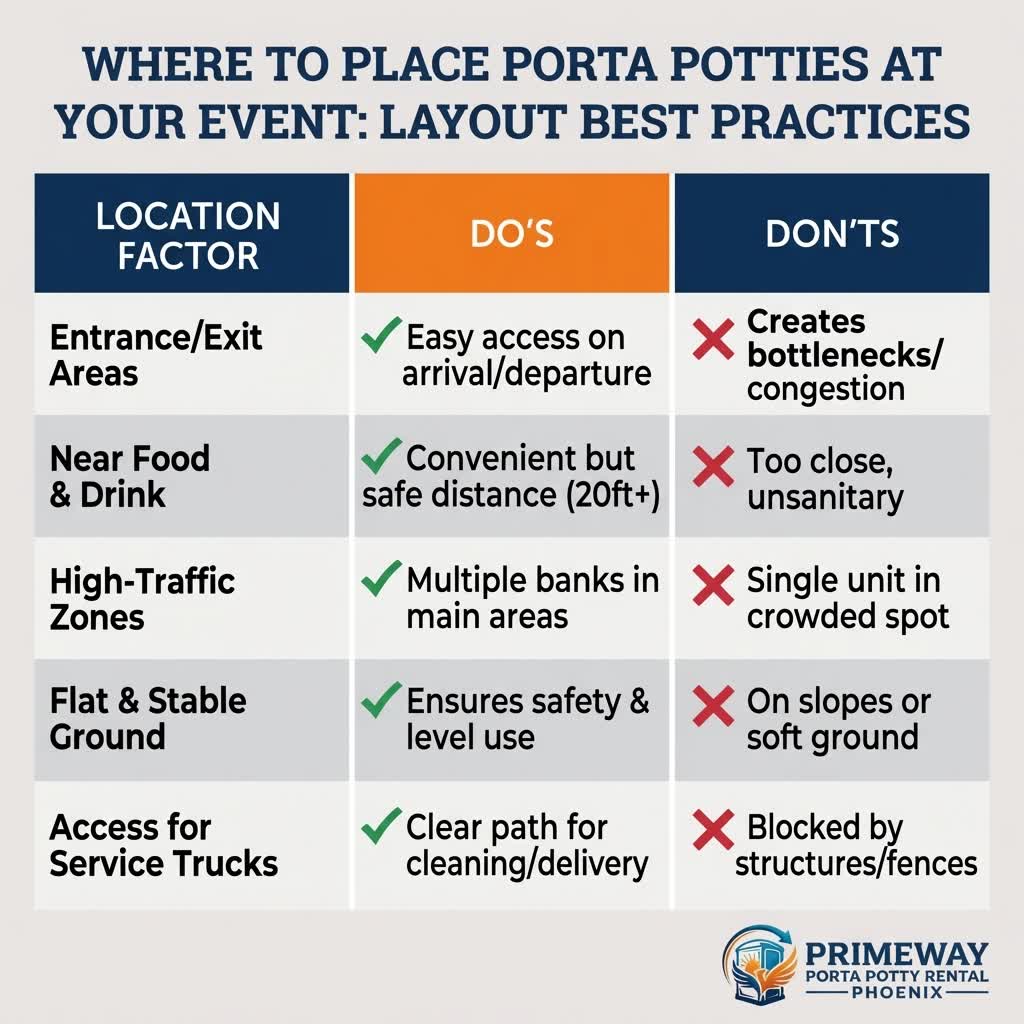
Rather than scattering individual porta potties across your venue, we strongly recommend creating clusters or "banks" of 3-6 units. This approach offers several advantages:
Benefits of Unit Clustering
| Benefit | Explanation |
|---|---|
| Reduced Wait Times | Guests see all available units and choose the shortest line |
| Easier Service | Maintenance trucks access all units in one stop |
| Better Traffic Management | Lines form in predictable, contained areas |
| Improved Security | Staff can monitor one area rather than multiple scattered locations |
| Aesthetic Control | Single screening structure hides multiple units |
Optimal Cluster Configuration
When creating unit clusters, arrange them in a shallow arc or straight line rather than a tight circle. This configuration:
- Prevents users from facing each other when entering/exiting
- Creates natural queueing areas without blocking doorways
- Allows service access to all units
- Distributes any odors away from waiting guests
Leave 6-8 feet between individual units and 10-12 feet of clearance in front of doors for lines and accessibility.
Accessibility and ADA Compliance
Federal ADA requirements mandate that at least 5% of your porta potties (minimum one unit) must be ADA-compliant. But compliance doesn't end with unit selection — placement is equally critical.
ADA Placement Requirements
- Accessible routes: Paved or firm, stable surfaces from all event areas to ADA units
- No steps or barriers: Level access without curbs, stairs, or steep slopes
- Clear width: Minimum 36-inch wide pathways to accessible units
- Signage: Visible identification of accessible units
- Proximity: ADA units should be as conveniently located as standard units, not hidden away
Inclusive Placement Best Practices
Beyond legal compliance, consider these inclusive placement strategies:
- Position ADA units at the end of clusters where door swing doesn't obstruct pathways
- Ensure adequate space for caregivers to assist if needed
- Consider lighting for evening events — accessible routes must remain visible and safe
- Provide seating near accessible units for those who may need to rest while waiting
For more on ADA requirements, see our guide to ADA-compliant porta potty rentals.
Managing Odor and Aesthetics
No one wants porta potties to be the memorable part of their event. Strategic placement helps minimize both visual and olfactory impact.
Working With Wind Direction
Phoenix's prevailing winds typically come from the west. When possible, position porta potties:
- Downwind from dining areas, ceremony spaces, and high-traffic zones
- Where buildings, walls, or landscaping can block wind carrying odors
- Away from HVAC intake vents if placing near buildings
If you're unfamiliar with local wind patterns, check weather data for your event date or consult with your venue about typical conditions.
Visual Screening Strategies
Effective screening improves aesthetics without sacrificing accessibility:
| Screening Option | Best For | Considerations |
|---|---|---|
| Natural Landscaping | Garden venues, rustic settings | Existing trees, shrubs; requires advance planning |
| Fencing/Fabric Panels | Weddings, corporate events | Decorative options available; ensure adequate ventilation |
| Pipe & Drape | Formal events, galas | Elegant appearance; requires professional installation |
| Tent Walls | Tented receptions | Creates separate "restroom tent" area |
| Decorative Planters | Upscale events | Attractive but requires advance coordination |
Always ensure screening doesn't block ventilation, create fire hazards, or impede emergency access.
Lighting and Evening Events
Phoenix's beautiful evening weather makes nighttime events popular, but inadequate lighting around porta potties creates safety hazards and guest dissatisfaction.
Lighting Requirements
- Pathway lighting: Illuminated routes from main event areas to restrooms
- Unit identification: Clear visibility of which doors are available (green/red indicators or backlit signs)
- Queue area lighting: Adequate light for guests waiting in line
- Interior options: Solar or battery-powered interior lights for units without built-in lighting
Security Considerations
Remote restroom areas can become security concerns after dark:
- Position units within sight of security personnel or camera coverage when possible
- Create clear sightlines by avoiding blind corners or dense screening
- Consider lighting that illuminates without creating harsh shadows
- For large events, station attendants near remote restroom clusters
Planning an Event in Phoenix?
Our team can help you design the optimal porta potty layout for your venue.
Call (602) 669-0858Service Access and Maintenance Considerations
For multi-day events, your porta potties will require servicing. Placement affects how easily our team can maintain units throughout your rental.
Service Vehicle Requirements
Our service trucks need:
- Access within 25-50 feet: Hoses connect from truck to unit for pumping
- Firm ground: Service trucks are heavy; soft ground creates safety hazards
- Clearance: Adequate space to maneuver and park
- Access timing: Ability to reach units during service windows without disrupting events
Planning for Service During Events
For festivals or multi-day events, coordinate service timing with your schedule:
- Early morning service (6-8 AM) before guests arrive
- Overnight service for 24-hour events
- Rotating unit closures during service to maintain availability
Placement Mistakes to Avoid
Learning from common errors can save you from guest complaints and logistical headaches:
The "Too Far" Problem
Placing units at the distant edge of a venue may seem aesthetically preferable, but guests will complain about the walk — especially children, elderly attendees, and those with mobility challenges. Keep units within reasonable distance or provide shuttle options for sprawling venues.
The "Hidden" Problem
While you don't want porta potties as your event's centerpiece, making them too difficult to find creates frustration. Use clear signage, lighting, or staff direction to help guests locate facilities easily.
The "Single Point of Failure" Problem
One large cluster of units at a 500-person event creates bottlenecks and long walks for some guests. Distribute facilities strategically across your venue.
The "Afterthought" Problem
Porta potty placement should be part of your initial venue planning, not a last-minute decision. Prime locations may be claimed by other vendors, or you may discover access limitations too late.
The "Ground Condition" Problem
That flat grassy area looks perfect until 200 guests have compacted the soil into a muddy mess. Consider ground protection, especially for multi-day events or if rain is possible.
Site-Specific Considerations for Phoenix Venues
Phoenix's unique climate and landscape create specific placement considerations:
Desert Heat Management
During warm months, unit placement affects internal temperatures:
- Shade when possible: Units in direct sun become uncomfortably hot; partial shade helps
- Ventilation: Ensure units aren't placed where airflow is blocked
- Proximity to hydration: Place units near water stations so guests can rehydrate after bathroom trips in heat
For more on managing porta potties in extreme heat, see our guide to renting porta potties in Phoenix summer heat.
Desert Landscaping
Many Phoenix venues feature xeriscaping with rocks, gravel, and native plants:
- Use plywood or ground protection mats to prevent rocks from damaging unit bases
- Consider dust — gravel surfaces create more dust than grass or pavement
- Watch for cacti and spiky plants when creating pathways to units
Monsoon Season Considerations
If your event falls during monsoon season (June-September):
- Avoid low-lying areas prone to flooding
- Ensure units are secured against high winds
- Consider backup indoor facilities if severe weather is forecast
Creating Your Placement Plan: A Step-by-Step Approach
Ready to create your porta potty placement strategy? Follow this process:
Step 1: Obtain Accurate Site Plans
Get detailed venue maps showing dimensions, elevation changes, utility locations, and permanent structures. Walk the site yourself to identify nuances maps might miss.
Step 2: Identify High-Traffic Zones
Mark main entrances, dining areas, bars, stages, and other focal points. These drive restroom demand.
Step 3: Locate Potential Placement Sites
Identify 2-4 potential cluster locations (depending on event size) that offer:
- Level, firm ground
- Service vehicle access
- Reasonable proximity to high-traffic areas
- Screening opportunities
- Good drainage
Step 4: Consider Guest Experience
For each potential location, evaluate:
- Walking distance from various event areas
- Visual and olfactory impact on nearby activities
- Accessibility for all guests
- Evening lighting requirements
Step 5: Finalize and Communicate
Once you've selected locations:
- Mark exact positions with flags or paint for delivery day
- Communicate placements to all vendors who need to know
- Confirm with your rental provider that placement is feasible
- Include restroom locations on event maps or signage
Conclusion
Thoughtful porta potty placement transforms a necessary logistical requirement into a seamless part of your guest experience. By considering convenience, accessibility, aesthetics, and practical requirements, you create a layout that serves your attendees while maintaining the atmosphere you've worked hard to create.
At Primeway Porta Potty Rental Phoenix, we're happy to visit your venue and provide placement recommendations based on our experience with thousands of Phoenix-area events. Our team understands the unique challenges of desert venues, urban locations, and everything in between.
Whether you're planning an intimate backyard wedding or a massive festival, proper porta potty placement sets the foundation for guest satisfaction. Contact us today for expert guidance on your upcoming event.