Key Takeaways
- Emergency sanitation prevents disease outbreaks in disaster-affected communities
- Rapid deployment capabilities ensure facilities arrive within hours of activation
- FEMA and emergency management agencies require pre-qualified sanitation vendors
- Phoenix-area risks include wildfires, flash floods, extreme heat, and power grid failures
- Long-term disaster recovery may require weeks or months of sustained sanitation support
When disaster strikes the Phoenix metropolitan area—whether from wildfires racing through the Tonto National Forest, flash floods surging through desert washes, extended power outages during extreme heat events, or infrastructure failures affecting municipal water systems—basic human necessities become critical emergency resources. Among the most urgent needs in any disaster response scenario is adequate sanitation. Without functioning toilets and hand-washing facilities, displaced populations face immediate health risks from disease outbreaks, while first responders and relief workers cannot maintain the hygiene standards necessary for sustained operations.
At Primeway Porta Potty Rental Phoenix, we maintain emergency response capabilities specifically designed to support government agencies, emergency management departments, relief organizations, and community partners during crisis situations. Understanding the unique requirements of disaster relief portable sanitation helps ensure that when the worst happens, Phoenix-area communities have access to the infrastructure necessary for public health and human dignity.
The Critical Role of Sanitation in Disaster Response
Disaster scenarios create perfect conditions for public health emergencies. Displaced populations gather in shelters, evacuation centers, or informal encampments. Existing infrastructure may be damaged, overwhelmed, or completely non-functional. Water supplies become contaminated or scarce. Under these conditions, the absence of adequate sanitation facilities can trigger rapid disease transmission through fecal-oral routes, creating secondary health crises that compound the original disaster's impact.
Historical data from major disasters demonstrates this risk clearly. Following Hurricane Katrina, poor sanitation conditions in the Superdome and Convention Center contributed to significant public health challenges. The 2010 Haiti earthquake triggered a cholera outbreak that killed thousands—an outcome directly attributable to inadequate sanitation infrastructure in displacement camps. While Phoenix may not face hurricane risks, our region's specific hazards create similar potential for sanitation emergencies.
Beyond disease prevention, emergency sanitation serves psychological and social functions. Maintaining personal dignity through access to private restroom facilities helps preserve mental health during traumatic displacement. Gender-specific security concerns make adequate facilities essential for protecting vulnerable populations. For families with young children, elderly members, or individuals with medical conditions, accessible sanitation literally determines whether they can remain in emergency shelters or must seek alternative—often less safe—accommodations.
Phoenix-Area Disaster Risks and Sanitation Implications
The Sonoran Desert environment creates distinctive emergency scenarios that shape sanitation planning requirements. Understanding these regional risks helps emergency managers and community organizations prepare appropriate response capabilities.
Wildfire Evacuations
Arizona's wildfire season extends from late spring through fall, with major fires regularly forcing evacuations in communities bordering national forests and wilderness areas. When communities like Pine, Strawberry, or Crown King face evacuation orders, thousands of residents may require emergency shelter with adequate sanitation facilities. Extended fire suppression efforts can keep evacuees displaced for days or weeks, creating sustained demand for portable restroom infrastructure.
Wildfire-specific considerations include air quality concerns that may limit outdoor activities, meaning portable restrooms must be positioned to minimize exposure to smoke and particulate matter. Fire camps supporting hundreds or thousands of firefighters require massive sanitation infrastructure deployment to remote locations with limited access to water and power.
Flash Flooding and Monsoon Damage
Phoenix's summer monsoon season brings intense, localized rainfall that overwhelms desert drainage systems. Flash flooding can damage municipal sewer infrastructure, contaminate water supplies, and render existing restroom facilities inoperable. Mobile home parks, low-income communities, and areas with aging infrastructure face particular vulnerability.
Flood damage creates unique sanitation challenges because standing water may make ground placement of portable units difficult or hazardous. Contaminated floodwaters require careful decontamination protocols for any deployed equipment. Communities affected by flooding may require longer-term sanitation support as they rebuild damaged permanent infrastructure.
Extreme Heat and Power Grid Failures
Phoenix summers regularly produce temperatures exceeding 115°F, creating life-threatening conditions without climate control. When power grid failures occur—whether from storm damage, equipment failure, or excessive demand—residents lose air conditioning, and municipal water pumping systems may fail. Heat shelters become necessary to prevent heat-related deaths, and these shelters require immediate sanitation support.
Extreme heat significantly complicates portable restroom operations. Units positioned in direct sunlight can become dangerously hot inside, potentially causing burns or heat illness for users. Providers must deploy units with enhanced ventilation, position them in shaded areas when possible, and increase service frequency to prevent the rapid bacterial growth that occurs in hot conditions.

Emergency Response Capabilities and Deployment
Effective emergency sanitation requires capabilities that differ significantly from standard rental operations. Standard porta potty deployments typically allow for advance booking, predictable quantities, and planned logistics. Emergency response demands 24/7 availability, rapid scalability, and deployment to challenging locations under adverse conditions.
Rapid Deployment Infrastructure
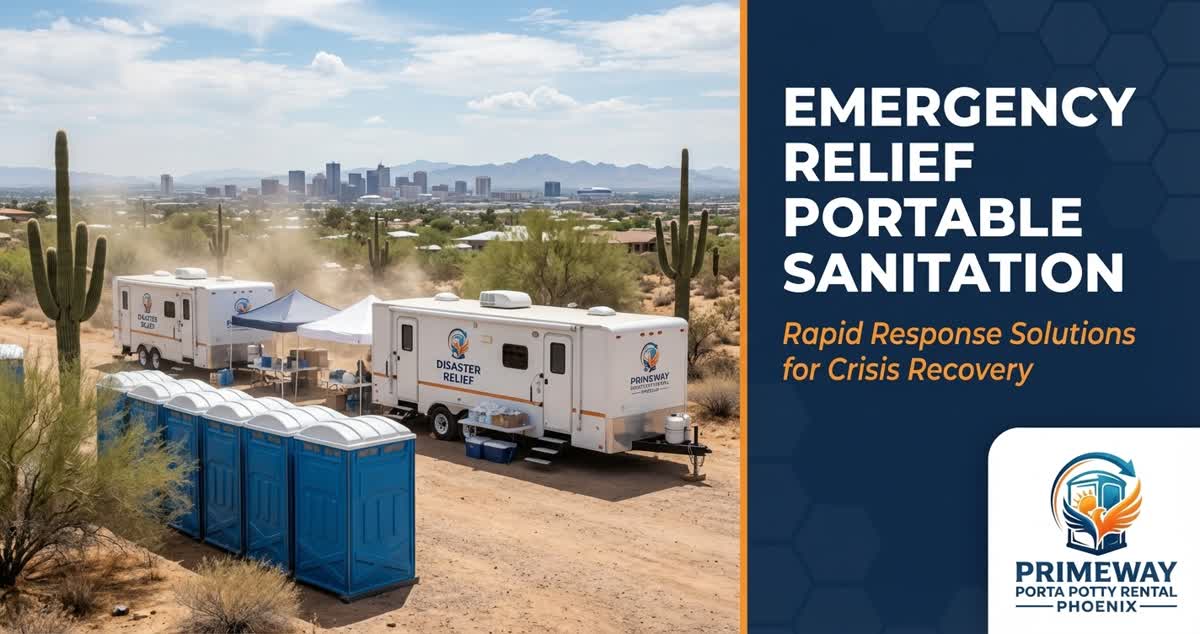
Emergency-ready portable sanitation providers maintain dedicated response inventories separate from standard rental stock. These units remain prepped and ready for immediate deployment, with trucks and drivers on standby for emergency activation. Leading providers can deliver initial units to Phoenix-area locations within two to four hours of receiving emergency requests, with scaled deployment following as needs become clearer.
Deployment capabilities include specialized equipment for challenging access situations—rough-terrain vehicles for wildfire camps, pump trucks for locations without sewer connections, and generators or solar power systems for lighting and ventilation where grid power is unavailable.
Coordinated Response with Emergency Agencies
Effective emergency sanitation requires integration with broader response frameworks. Maricopa County Emergency Management, the Arizona Department of Emergency and Military Affairs, FEMA, and various non-governmental relief organizations each maintain systems for coordinating resource deployment during disasters. Portable sanitation providers serving emergency contracts must understand these systems and maintain the documentation, insurance, and operational capabilities to participate in coordinated response efforts.
Pre-disaster planning relationships prove far more effective than emergency procurement. When providers have established relationships with emergency agencies, pre-negotiated contracts, and mutual understanding of capabilities and requirements, response times improve dramatically and coordination challenges decrease significantly.
Scalable Capacity for Mass Care
Major disasters may require sanitation capacity far exceeding normal commercial availability. A single large evacuation shelter might require 50-100 portable restroom units, while fire camps supporting thousands of firefighters need similar quantities plus specialized units for command centers, medical facilities, and dining operations. Emergency-capable providers must access regional or national inventories when local capacity proves insufficient.
Mass care sanitation also requires enhanced service capabilities. Standard weekly servicing proves inadequate for high-use emergency deployment. Daily or twice-daily servicing may be necessary during peak occupancy periods, requiring dedicated service crews working extended shifts throughout the emergency period.
Emergency Sanitation Response Available 24/7
Government agencies and emergency managers: Call our emergency hotline for immediate deployment.
Call (602) 669-0858Types of Emergency Sanitation Deployments
Different disaster scenarios require different sanitation configurations. Understanding the available options helps emergency managers match resources to specific situations effectively.
| Deployment Type | Best For | Typical Configuration |
|---|---|---|
| Evacuation Shelter | Displaced residents, families, vulnerable populations | Standard and ADA units, hand-wash stations, baby changing stations, enhanced cleaning schedule |
| First Responder Base Camp | Firefighters, search & rescue teams, utility workers | High-capacity units, shower trailers, hand-wash stations, rapid deployment capabilities |
| Mobile Medical Units | Field hospitals, vaccination sites, emergency clinics | Medical-grade hand-wash stations, dedicated staff facilities, infection control protocols |
| Debris Removal Operations | Cleanup crews, volunteer teams | Durable standard units, bulk capacity, flexible positioning as work progresses |
| Long-Term Recovery | Communities rebuilding, temporary housing | Sustained service over weeks/months, residential-style comfort units, community-appropriate aesthetics |
Health and Safety Protocols for Emergency Sanitation
Emergency sanitation operations must maintain rigorous health and safety standards even while operating under challenging, time-sensitive conditions. Professional providers follow established protocols that protect both users and service personnel.
Infection control measures include proper waste containment, regular disinfection of high-touch surfaces, and appropriate personal protective equipment for service crews. During disease outbreaks or pandemic conditions, these protocols may be enhanced with additional disinfection steps, contactless service procedures, and specialized waste handling.
Worker safety in emergency conditions requires additional attention. Service personnel may work extended hours in hazardous environments—extreme heat, fire smoke, flood damage, or unstable structures. Professional providers maintain safety programs that address these risks, including heat illness prevention protocols, respiratory protection when needed, and procedures for working in damaged or unstable areas.
For non-emergency construction deployments, worker sanitation is governed by strict federal rules. See our complete breakdown of OSHA Portable Toilet Requirements for Construction Sites in 2026 to understand OSHA's unit ratios, service frequency mandates, and distance requirements.

Long-Term Recovery Support
While media attention focuses on immediate disaster response, sanitation needs often extend far longer than the initial emergency phase. Communities recovering from major disasters may face months without functional permanent infrastructure. Mobile home parks, affordable housing communities, and rural areas with limited resources particularly face extended recovery periods.
Long-term disaster sanitation requires different approaches than emergency deployment. Rather than rapid-response capabilities, sustained service over weeks or months becomes the priority. Units may need to blend better with residential neighborhoods where aesthetics matter more than in emergency shelters. Service scheduling must adapt to ongoing community life rather than emergency operations.
Recovery-phase sanitation also intersects with broader community rebuilding efforts. As FEMA trailers replace destroyed housing, as schools reopen in temporary facilities, and as businesses resume operations in repaired or relocated spaces, portable sanitation provides the essential infrastructure that allows these recovery milestones to occur.
Preparedness Planning for Organizations
Organizations that may need emergency sanitation—including government agencies, large employers, healthcare facilities, schools, and community organizations—benefit from advance planning rather than emergency procurement. Pre-established relationships with portable sanitation providers, documented requirements, and clear activation procedures enable faster, more effective response when disasters occur.
Key elements of sanitation preparedness planning include identifying potential deployment sites, establishing quantity requirements for different scenarios, understanding accessibility and ADA compliance needs, and coordinating with broader emergency response plans. Organizations should also consider how they will communicate sanitation availability to affected populations, particularly in multilingual communities common throughout Phoenix.
For community organizations serving vulnerable populations—homeless shelters, food banks, senior centers, and healthcare clinics—sanitation preparedness may literally mean the difference between continuing operations during emergencies or closing doors when they're most needed. Partnering with flexible, responsive portable sanitation providers helps ensure these critical community resources remain available regardless of external conditions.
As climate change increases the frequency and severity of extreme weather events, emergency sanitation capabilities become increasingly important community infrastructure. Phoenix-area organizations seeking to build resilience against wildfire, flooding, heat emergencies, and other disaster scenarios should include portable sanitation partnerships in their preparedness planning, ensuring that when the worst happens, basic human dignity and public health remain protected.